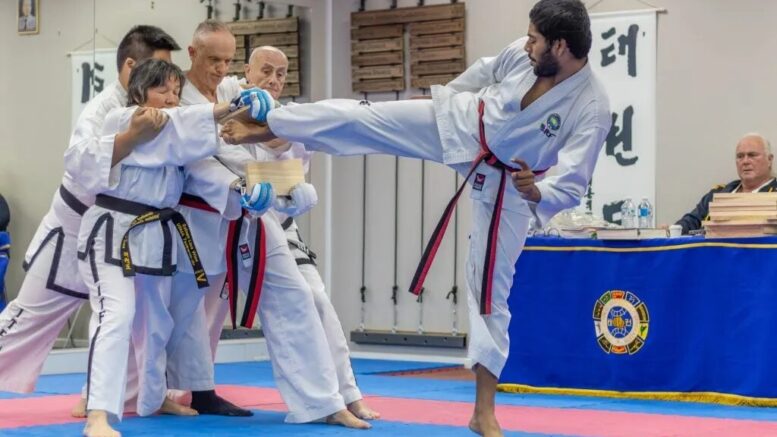
USMA Taekwondo, at 348A Clayton Road, Clayton, connects a local training room with a martial arts story that began in South Australia in 1970. That was when instructor Spiridon Cariotis started learning taekwondo; in 1993 he founded the school now known as United Schools of Martial Arts. Its Clayton programs make room for young children, complete beginners, experienced students and parents interested in training alongside their children. The common thread is the martial art itself, approached through patterns, sparring and structured practice rather than a single kind of class for everyone.
A teacher's story stretching back to 1970
Spiridon Cariotis began taekwondo as a young student in South Australia. His subsequent work has included teaching, coaching and examining, with the school describing more than fifty years of involvement in martial arts. Founding USMA in 1993 gave that experience a continuing local home and a new generation of students to teach.
His background also reaches into international competition. According to the school's account, Cariotis served as an Australian National Team Coach from 2002 to 2019, coaching athletes at world championships and other international events. The teaching story therefore spans the first steps of a beginner and the demands of competition, two different ends of the same martial art.
At Clayton, the everyday emphasis is on technical accuracy, progression and understanding rather than memorisation alone. Cariotis continues to teach students across ages and levels. That gives the school a clear centre: an instructor whose own training began decades before USMA opened, working with people who may be arriving for their very first class. The history sits behind the practice without requiring a newcomer to arrive with any history of their own.
Cariotis' wider experience includes karate, boxing and judo as well as taekwondo, with roles as an international instructor, examiner and referee. USMA itself follows ITF taekwondo and is affiliated with the International Taekwon-Do Masters Society. Those connections place the Clayton school within a wider martial arts community, while its daily work remains grounded in the local class: teaching techniques, organising practice and helping students understand what they are doing.
A beginning that fits the student
The Pee Wee program introduces children aged five to eight to the school. Beginners and junior belts have another program, covering foundational techniques, patterns and sparring skills. These distinctions give a family a practical starting point: not simply whether taekwondo sounds interesting, but which class is intended for a child's age and experience.
Adults are part of the picture too. USMA welcomes people starting from scratch, returning after time away or arriving with previous martial arts experience. Each brings a different story into the training room. Someone who remembers classes from years earlier may want to find a way back, while a complete beginner may simply be curious about learning a martial art for the first time.
The school's structure gives those different beginnings room to be discussed. A conversation about age, experience and the available program can establish the appropriate first class. The emphasis is on finding a place to start, rather than expecting every student to take the same route or move at the same pace. A white belt is treated as a legitimate beginning, not an obstacle to belonging in the room.
Patterns, sparring and the shape of a week
USMA's timetable separates some classes by training focus as well as level. Monday includes beginner and junior sparring, followed by adult and senior sparring. Wednesday is organised around patterns, with junior, intermediate and senior or black-belt sessions at different times. The week makes space for different aspects of the art instead of treating practice as one undifferentiated activity.
Patterns give a sequence of techniques a place in the program; sparring brings another kind of practice and interaction. The school's emphasis on understanding fits that variety. Repetition is part of learning, but it sits alongside the question of how a movement is performed and what a student is working towards at that level.
Mixed classes on Thursday evening and Saturday morning bring students of different ranks into the same wider session. Senior students and black belts also assist in classes, adding another connection between people at different stages of their training. For a newcomer, the room can include both an instructor's experience and the example of someone who remembers being at the beginning more recently.
Parents can become participants too
The school actively encourages parents to consider training rather than remaining only on the sidelines. That gives a household another way to approach an activity: as an interest that more than one family member can explore. Adults and children do not have to be interested in exactly the same part of taekwondo for the wider school community to give them common ground.
A shared interest can make the week's training something to talk about beyond the class itself. A parent beginning a new skill and a child working through their own program each have something to learn. The arrangement depends on the classes suited to the family, but the invitation makes clear that adult participation belongs in the school's picture of family life.
Friends of USMA adds another layer. The school describes it as a non-profit organisation founded by students and families, with camps, social activities, fundraising and support for tournaments among its areas of involvement. Those activities extend the connections around training, offering ways to be involved beyond a particular session. Current events can be discussed with the school as part of finding out how the community works.
The martial art, not only the competition
USMA identifies its approach as focused on taekwondo as a martial art rather than solely as a sport. Courtesy, integrity, perseverance, self-control and indomitable spirit appear among the principles it sets out. Respect for other students and for the dojang, the training space, forms part of the expectation placed on participants.
Competition has a place in the school's history, with students having represented Australia internationally. Everyday training, however, also includes people whose aim is simply to learn and practise. A program that includes children, adult beginners and senior belts has several kinds of commitment within it, without needing every participant to picture the same destination.
Classes run Monday to Thursday evenings and on Saturday morning, with Friday closed. Saturday's mixed class is listed from 10am to 11am. The current timetable and class suitability are worth discussing before a first visit, along with what to wear and bring. Once those details are settled, a prospective student can arrive for an introduction to the actual school: its people, its routines and its way of practising taekwondo.
Visit USMA Taekwondo
USMA's Clayton story joins a long-serving instructor with people taking very different first steps. Patterns, sparring, junior programs and adult classes all belong under the same roof. For a local household curious about taekwondo, the next move is a conversation about where to begin, followed by a visit to the training room on Clayton Road.
USMA Taekwondo (United School of Martial Arts)
Address: 348A Clayton Road, Clayton VIC 3168
Phone: (03) 9543 2626
Hours: Classes Monday–Thursday evenings and Saturday morning; Friday closed; consult the current class-by-class timetable for the appropriate level. Public holiday arrangements and changes should be checked before visiting.
Website: https://www.usmataekwondo.com/
Email: info@usmataekwondo.com
Instagram: https://instagram.com/usmataekwondo
Facebook: https://www.facebook.com/usmataekwondo/